
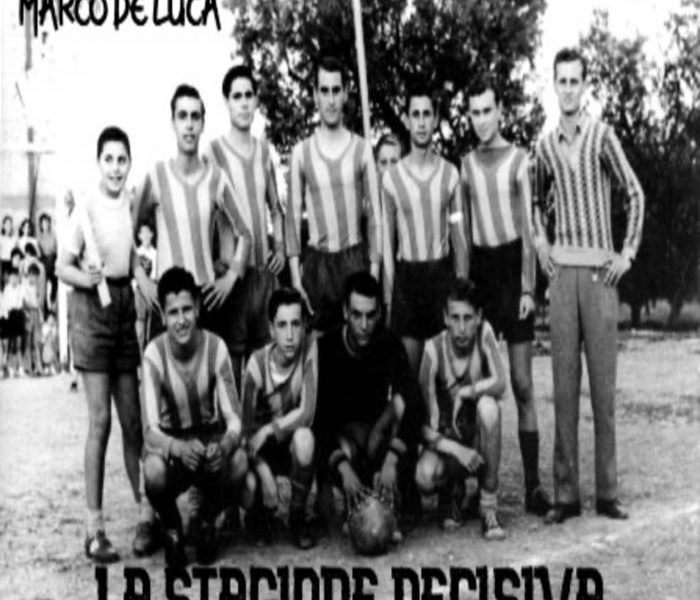
There’s a particular thrill that comes from encountering an album in a language you don’t speak fluently, yet somehow understand completely. La Stagione Decisiva, the fourth full-length from Italian singer-songwriter Marco De Luca, works precisely on that frequency. Even before the translated lyric sheet fills in the details, the record communicates its intent through texture, mood, and a deep emotional current that feels unmistakably human — and unmistakably urgent.
De Luca, who emerged in the ’90s with the band Sine and carried the influence of The Cure like a quiet flame through his early work, has always been interested in atmosphere as much as melody. But La Stagione Decisiva marks a clear evolution. Where his earlier albums leaned heavily on guitars and new-wave austerity, this record opens outward into a more psychedelic, keyboard-driven sound — one that feels less cloistered, more confrontational, and oddly more intimate at the same time.
The opener, “Videospazzatura” (“Video Trash”), makes that shift immediately clear. Built on a dense wall of sound, it echoes the sensory overload of U2’s Achtung Baby era and the media-satire chaos of Zoo TV, filtered through shoegaze haze and industrial grit. Guitars blur into sheets of noise, vocals swim in delay and reverb, and the message cuts sharply through the fog: a prophetic critique of televised suffering, written decades ago yet painfully relevant now. When De Luca spits out “videotrash,” it lands less like a slogan and more like a diagnosis.
“Il Mostro” (“The Monster”) doubles down on the darkness, pairing Cure-like guitar lines with a bass groove that nods subtly to Dylan’s “All Along the Watchtower.” The vocals are raw and unvarnished, placed starkly at the front of the mix. Lyrically, it dissects fear, ignorance, and the spectacle of violence — how easily horror becomes entertainment once it’s framed correctly. It’s dark power pop with real teeth, unafraid to take sonic risks or moral stands.
The album’s emotional center begins to reveal itself on “La Festa” (“The Party”), a slow-burn highlight that feels like the lights dimming mid-set, a disco ball scattering fractured reflections across a crowded room. It’s intimate, almost tender, capturing the quiet devastation of being alone in the middle of celebration. De Luca’s restraint here is striking; the song doesn’t demand attention so much as it earns it.
That sense of vulnerability deepens on “Alla Deriva” (“Adrift”), where phased synths and tremolo guitars ebb and flow like emotional tides. The vocals stand boldly in front, refusing to hide behind the production. Analog bleeps and blurred textures swirl around the listener, creating a sense of drift that mirrors the song’s lyrical fatigue and loss. It’s experimental without feeling indulgent — risk taken, risk rewarded.
“15 Anni” (“15 Years”) may be the album’s most quietly devastating track. Swirling phasers and layered synths create a dizzying sense of memory in motion, while the drums hover just beneath the surface, almost ghost-like. The lyrics — centered on adolescence, absence, and the cruel speed of time — hit with particular force when the final verse strips everything back, pushing the words directly into the spotlight. It’s imperfect, a little messy, and all the more powerful for it.
The intensity spikes again on “Un Uomo Gentile” (“A Gentle Man”), driven by pounding drums and heavily distorted guitars that recall My Bloody Valentine’s density and early Nine Inch Nails’ urgency — minus the nihilism. The bold panning choices (guitars hard right, drums hard left) feel deliberate and disorienting, forcing the listener to lean in. Lyrically, the song wrestles with kindness in a cynical world, asking whether gentleness is naïveté or quiet resistance.
At over six minutes, “Aspiranti Modelle” (“Aspiring Models”) unfolds patiently, its phased guitars and echo-laden vocals carrying one of the album’s most harrowing narratives. What begins as a dream shaped by television glamour dissolves into exploitation and survival. De Luca resists melodrama, letting repetition and space do the heavy lifting. The result is haunting, restrained, and deeply empathetic.
The closing track, “Il Giorno” (“The Day”), pushes the album to its outer edges. Buzzing feedback and controlled chaos turn sound itself into an instrument, blurring the line between noise and melody. It’s the most experimental moment on the record — and the perfect ending. Rather than resolve neatly, it reaches outward, grasping for truth, freedom, and something just beyond the noise.
La Stagione Decisiva translates, loosely, to The Decisive Season, and the title feels earned. This is an album that confronts media exploitation, fear, memory, and survival without posturing or sentimentality. De Luca doesn’t shout his convictions; he embeds them in sound, atmosphere, and lived-in storytelling. Even filtered through translation, the songs retain their emotional precision.
In an era obsessed with immediacy and gloss, Marco De Luca has made a record that rewards patience and demands attention — a work that feels both rooted in post-punk history and sharply attuned to the present moment. La Stagione Decisiva isn’t just a turning point in his catalog; it’s a reminder that meaningful art doesn’t need to speak your language to speak directly to you.
https://twitter.com/mdl71
https://www.facebook.com/pages/Marco-De-Luca/108812972482919
https://www.instagram.com/marcodeluca300/
STREAMING