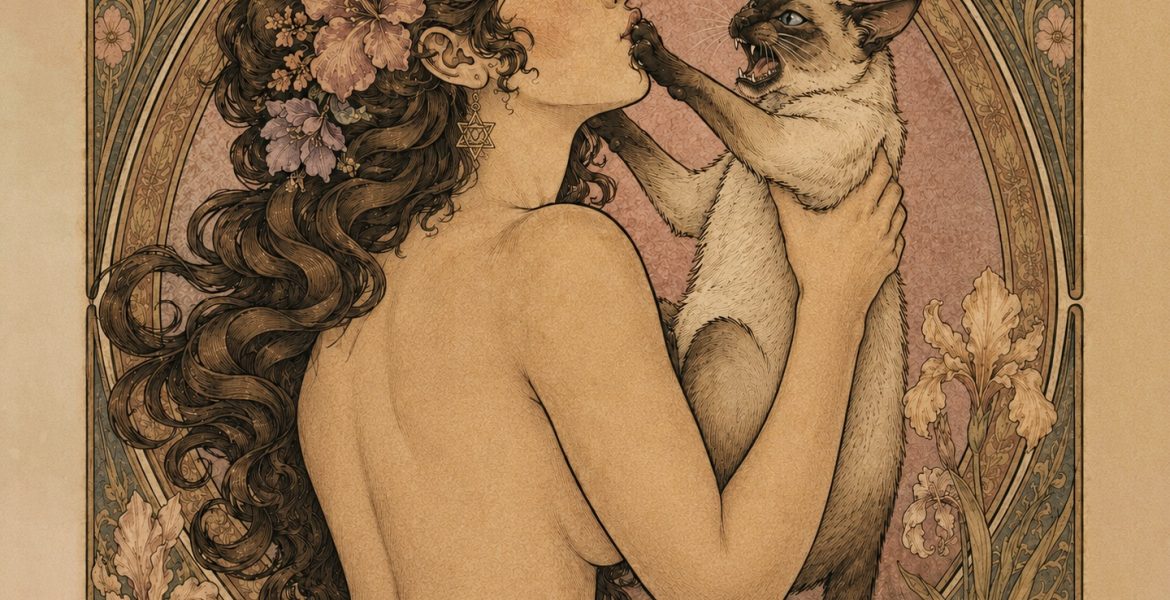
Kiss Tishka’s Hiss sounds like two friends disappearing into a basement with a stack of synthesizers, a guitar, a drum machine, a few classic records and several questionable ideas, and then emerging six songs later with something unexpectedly coherent. The Minneapolis duo of Andrew Scott Broste and Daniel J. Scott has built a strange little world where synthwave, indie rock, new wave, funk and psychedelic pop coexist without bothering to explain themselves. These songs are about bad judgment, obsession, escape, desire and the peculiar logic that takes over when the night gets late enough. They can be funny, menacing, dreamy or downright weird, sometimes within the same song.
The opening track, “Weekend,” establishes the aesthetic immediately. Thick analog synthesizers and restless arpeggios propel the song forward with the cinematic momentum of a lost 1980s soundtrack. There is a little Ben Gibbard in the vocal phrasing, but the backdrop belongs to neon streets, midnight drives with the windows rolled down. The lyrics turn the weekend into its own alternate reality, complete with parties, girlfriends, rule-breaking and the inevitable tragedy of morning arriving. Kiss Tishka understands the simple pleasure of making a song feel like a movie before the listener has even figured out the plot.
“Whatever She Wants” shifts into more traditional alternative rock, carrying a loose swagger that recalls R.E.M. at their most muscular. The song’s narrator is caught in the gravitational pull of a woman who seems capable of turning every bad idea into an irresistible invitation. Broste and Scott play the scenario for both comedy and danger, with the arrangement steadily reinforcing the feeling that the narrator has surrendered control. It is a clever portrait of romantic devotion pushed beyond reason, where affection starts looking suspiciously like self-preservation’s opposite.
Then comes “One Thing Right,” perhaps the EP’s most unexpected left turn. The reggae influence is unmistakable, but Kiss Tishka approaches it the way The Police once did, using the rhythm as a launching point rather than a destination. Crisp drums, guitar, keyboards and trumpet give the track an organic feel that contrasts nicely with the synthetic sheen elsewhere on Hiss. Lyrically, it dives into altered states, meditation and the possibility of seeing reality from the other side of the mirror. The repeated question, “Where will you go tonight,” gives the song an open-ended quality, as if the destination matters less than the willingness to leave.
“Criminal” brings the darkness back. Dense guitars and a tense, increasingly claustrophobic production create the sensation of watching a crime unfold from a nearby window. Sirens creep into the mix. A distant female voice sounds like a radio dispatcher. Helicopter noise hovers overhead. The arrangement keeps adding details until the song feels less like a conventional rock track than an increasingly frantic news report.
Its central question is more interesting than the crime itself: why does a criminal sometimes become a hero in the public imagination? The song toys with celebrity, violence, obsession and the strange cultural machinery that can turn an accused perpetrator into a folk figure. Kiss Tishka does not provide easy answers. Instead, it builds the tension until the inevitable handcuffs arrive.
“All the Love” changes the temperature completely. A funky bass line, silky synthesizer washes and an expansive groove bring Prince and Steely Dan into the same room, with a little Stevie Wonder hanging around the edges. The lyrics are sharper than the relaxed groove initially suggests, taking aim at hypocrisy, greed and people who demand obedience while giving very little of themselves. The extended instrumental ending is especially satisfying. Rather than rushing toward a tidy conclusion, the band lets the groove breathe and stretch, turning the final minutes into a miniature jam session.
“The River” closes Hiss with its boldest emotional pivot. The early-1980s new wave atmosphere suggests Talking Heads, while the song’s second-half guitar work introduces a psychedelic, almost Pink Floyd-like dimension. More importantly, it abandons the EP’s nocturnal anxiety for sunlight. The river becomes a place where the characters can finally stop running, scheming and questioning everything long enough to simply exist.
That contrast gives Hiss its shape. “Weekend” begins under cold neon lights, chasing thrills into the night. “The River” ends beneath a warm sun, with water moving steadily toward an unknown destination. Between them are parties, power struggles, altered states, criminal fantasies, righteous anger and a whole lot of questionable decision-making.
Kiss Tishka’s greatest strength is its refusal to settle on a single identity. Hiss sounds like a record assembled from half-remembered decades and private obsessions, but it never feels like a nostalgia exercise. The production is too curious, the arrangements too unpredictable and the songwriting too willing to take a strange turn. Broste and Scott have made an EP that understands something important about pop music: sometimes the most memorable songs are the ones that leave a little unexplained.
There is a cat named Tishka, apparently. Beyond that, the story remains deliberately unclear. After six songs like these, that feels exactly right.
https://artists.landr.com/991048595613