
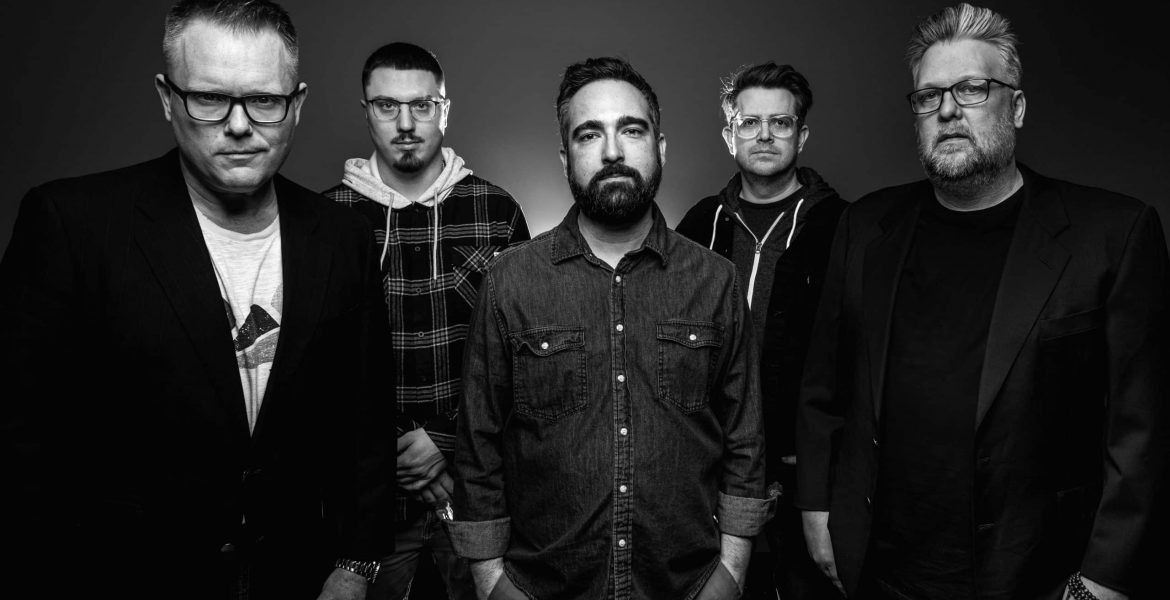
Blueprint Tokyo is:
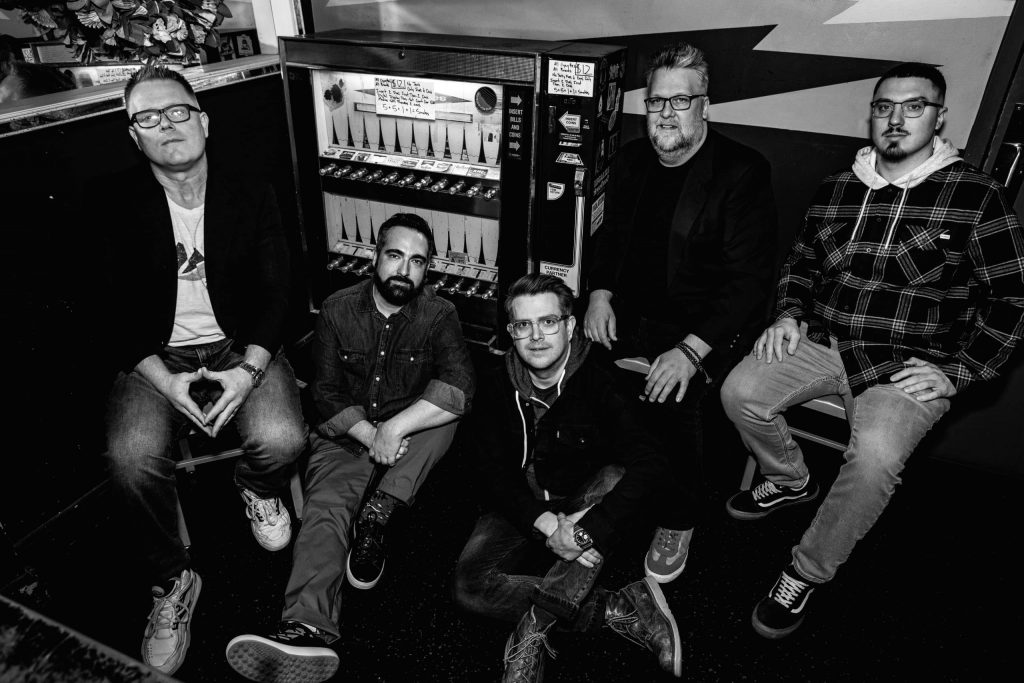
Kevin Dawson [vocals/guitar], Andy Hale [guitar, synth], Jed Owens [keys/synth], Matt Danner [bass], and Peter Bisek [drums].
Hi Blueprint Tokyo and welcome to College Radio Charts! How has your 2026 been so far? It seems you’ve been quite busy these past few months.
Busy is an understatement! We’ve been heads down finishing Dark New Days, getting the video for “Just Repeat Myself” shot and edited, playing shows including Norman Music Festival, and doing all the things that come with an actual release – press, playlisting, social, the whole machine. It’s been a lot but it’s the good kind of a lot.
Your new EP Dark New Days feels both emotionally heavy and strangely hopeful at the same time. What was happening in your world personally or creatively that shaped the mood of this record?
The band itself is a product of starting over. Kevin’s health crisis, the pandemic, working remotely across two countries, rebuilding the lineup – none of that is abstract for us, it’s just the actual story of how we got here. I think that history lives in the music whether we intend it to or not. When you’ve had to fight to keep something alive you don’t write casually about giving up. But you also don’t write naively about hope. You write about the in-between, which is where most of life actually happens anyway.
The title Dark New Days suggests a paradox — fresh starts wrapped in uncertainty. What does that phrase mean to you as a band?
That tension is exactly what we were going for. Dark and new aren’t opposites – sometimes the hardest things in your life also create the most clarity. A new day isn’t automatically a good one. But it’s still new. There’s still something to work with. The title felt honest about both halves of that without resolving the tension, which is really what the whole EP is doing across six songs.
Speaking of the band, how did you guys get your start?
Kevin and I had been playing together in a previous band for years. When Kevin got sick we had to stop. After he recovered and moved to Canada we eventually reconnected remotely and started writing again – just the two of us passing files back and forth across the border. Blueprint Tokyo grew out of that restart. We brought in a keys/synth player [Jed] and started playing shows as a three piece, then recruited a drummer [Peter] and bassist [Matt] to round out the five-piece we are now.
Did you come from a musical family yourself? What are some of your earliest musical memories growing up?
Neither Kevin nor I came from formally musical families – my dad played a little but nothing serious, and there were more musical people further out in my family tree, though never as a career. Kevin’s background was similar. I think that’s part of why we connected so easily when we first started playing together – we came from the same place, grew up on the same sounds, had the same relationship to music as something you loved rather than something you were trained in.
For me it was my parents having the oldies station on constantly in the car. Classic rock, Motown, early pop – the stuff that was already decades old but felt completely alive. I didn’t know those songs were culturally important. I just knew every word and sang every one of them. Kevin had his own version of that same story. That shared foundation – absorbing decades of great songwriting before either of us ever picked up an instrument – is probably where the melody obsession comes from for both of us. Before we ever played a note together we already agreed on what made a song matter.
“Orange Tiger” introduced listeners to this EP with a big, anthemic energy. Did you always know that would be the gateway track into this project?
Pretty much. It has that forward momentum from the first note – it announces itself. When you’re sequencing an EP you want something that tells the listener immediately what world they’re walking into. “Orange Tiger” does that. It’s urgent and it moves, but there’s also something searching underneath it. That felt like the right door into the rest of the record.
Was the writing and recording process on the new EP similar to what you’ve done in the past?
Similar in structure, different in confidence. The core process is the same – I typically write music and Kevin writes the lyrics and melody. But on this record there was less second-guessing. We’ve made enough music together now that we trust each other’s instincts more quickly. The other members are contributing more than they have previously which changes the energy too. It feels more like a band making a record and less like two people finishing our homework.
As a non-musician, I’m always curious: which comes first, the lyrics or the melody?
Music first, usually. I’ll build the outline of a song – chords, structure, the basic shape of the thing – and Kevin will refine the arrangement, find the melody and words that live inside it. This version of the split works really well for us. There’s something about writing words to someone else’s music that forces you to respond to what the song is actually feeling rather than what you planned to say.
Did you work with a producer on this new EP? If so, what did their role look like both in the studio and before the recording began?
We work with an amazingly talented mixer who brings a real shape to the final sound. The production direction comes from us but having someone with fresh ears who can push back on choices is invaluable. A lot of what makes Dark New Days sound the way it does comes from being willing to strip things back when the instinct is to add more. That restraint doesn’t always come naturally when you’re inside the songs every day.
Your debut album Neon Circuits and the Mission of Hope established a very cinematic, emotionally layered sound. In what ways did you want Dark New Days to push beyond that foundation?
Neon Circuits was about establishing range – showing we could do a lot of different things across a long format. Dark New Days is about focus. Six songs, one emotional territory, nothing wasted. We wanted to see what happened when we stopped trying to prove the range and just committed fully to a point of view. The answer is that the songs hit harder. Constraint turned out to be useful.
There’s a real balance in your music between tight songcraft and atmospheric space. How do you know when a song needs more layers versus when it needs restraint?
Honestly you feel it more than you decide it. When a song starts to feel crowded – when you can’t hear the thing that made you write it in the first place – that’s when you pull back. The test we use informally is whether the vocal melody can carry the song on its own. If it can, everything else is in service of that. If it can’t, adding more production isn’t going to fix it. You have to go back and fix the song.
The rhythm section across this EP is incredibly driving and purposeful. How important is groove to Blueprint Tokyo’s identity compared to melody and lyrics?
Groove is the thing that makes melody feel inevitable rather than arbitrary. You can write the most beautiful melody in the world and if the rhythm underneath it isn’t pulling you forward it just sits there. We think about the rhythm section as the thing that gives the listener permission to feel what the song is asking them to feel. When it’s right you don’t notice it. When it’s wrong you can’t hear anything else.
“Nite Valerie” has a different kind of late-night energy to it. What’s the story behind this track that closes out the EP?
“Nite Valerie” is the most personal thing on the record. It’s about a specific type of person in a specific type of moment – the kind of love that time and distance make you appreciate differently. We chose it to close the record because after five songs about staying in things and pushing through things, we wanted to end somewhere quiet and specific. Not a summary, just a simple resolution.
Who would you say are some of your biggest influences?
The list is long and probably surprising in its range. The Cure, Smashing Pumpkins, Pink Floyd, Beach Boys, Tears for Fears, Depeche Mode, Nine Inch Nails, The Police, Queen, Coldplay, The Killers, Manchester Orchestra, Jimmy Eat World. The common thread across almost all of them is strong melody and the tension between electronics and organic instruments. We grew up on music from the 60s through the 90s and we’ve never pretended otherwise. Those sounds are our lens that we look through music at.
Somewhat related, are there any dream collaborators you’d like to work with?
Trent Reznor would change what we think is possible sonically. Robert Smith for obvious reasons – the way he writes melody inside darkness is something we’ve been studying for years. On the production side, Jacknife Lee has shaped some of our favorite records. Closer to our own world, a co-write with the guys from Nothing But Thieves would be fascinating — they operate in a similar space but push it further than most bands dare.
What does collaboration look like within Blueprint Tokyo? Do songs usually start with one member’s idea, or are they built collectively from the ground up?
Kevin and I are usually the core of it – I typically bring the music while he brings the words and melody, though we’ve been known to flip that entirely when the song calls for it. The other members bring their own voices to their parts and that’s becoming more true with each release as everyone gets more comfortable and more invested in the material. At the end of the day the only thing that matters is the best possible version of the song. That’s what drives every decision.
With Dark New Days just released, how does this EP represent where the band is right now versus where you were during your debut record?
Neon Circuits was us proving we could do it. Dark New Days is us knowing we can. That sounds like a small shift but it changes everything about how you make decisions in the studio and in the writing room. On the debut we were chasing spectacle – and that ambition wasn’t wrong, but it also meant endlessly questioning whether every song belonged, whether it was good enough, whether we were good enough. On this EP we stopped asking those questions and just made the record we wanted to make. The confidence isn’t arrogance. It’s what happens when you finally decide to trust your own opinions.
A music video for “Just Repeat Myself” drops on YouTube right about when this interview goes live. What was the experience like creating that video, and who did you work with on the production?
We worked with an amazing local filmmaker on the video and the experience was genuinely collaborative. The concept was straightforward – shot to feel like the band is actually inside the song rather than performing for a camera. We wanted it to feel immediate and honest rather than produced within an inch of its life. The cinematography came out even better than we expected.
For new listeners discovering Blueprint Tokyo through this EP, what song do you think best captures the heart of who you are as a band?
“Just Repeat Myself” is probably the most accessible entry point – it’s immediate, the hook is strong, and the emotional logic is simple enough to feel on a first listen. But if someone wants to know what we’re actually about at the core, I’d actually send them to “Nite Valerie.” It’s quieter, it’s more specific, and it asks more of the listener. Everything we care about as a band is in that song – restraint, specificity, even a willingness to end somewhere small and true instead of somewhere big and safe.
Thanks so much for spending some time with us today! What’s next for Blueprint Tokyo and where can people go to find out more about you and your music?
We’re always writing. The plan is to keep the momentum going – more music, more shows, building on what Dark New Days started. We’re not a band that does well sitting still. Everything lives at blueprinttokyo.com and we’re active on Instagram, Facebook, TikTok, and YouTube at @blueprinttokyo. Dark New Days is out now on all streaming platforms – Spotify, Apple Music, everywhere you listen. Come find us.